Article Sidebar
Main Article Content
Abstract
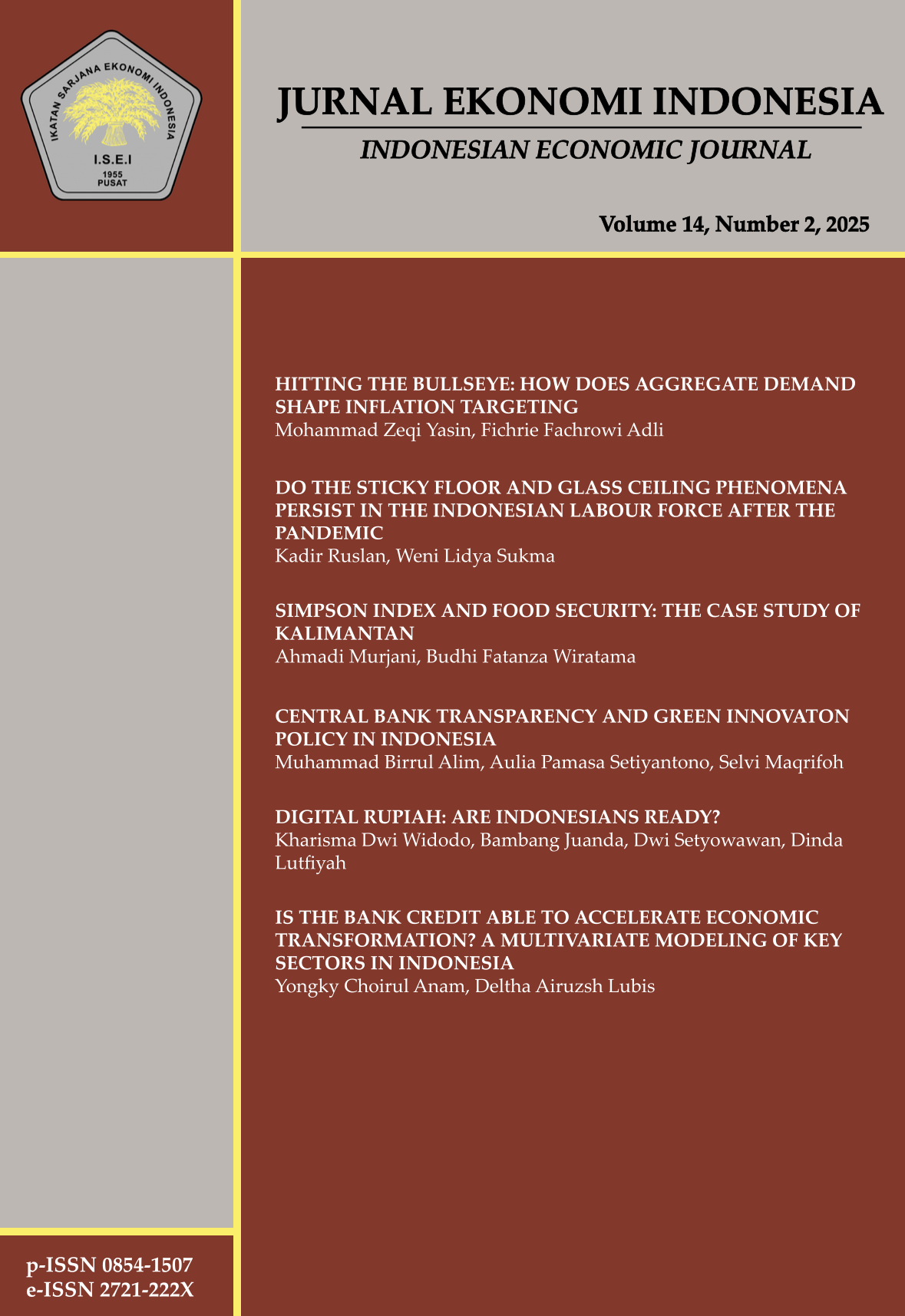
We aim to determine whether components of aggregate demand contribute to regional inflation reaching the threshold level. By using regional-level datasets of Indonesian cities from 2010 to 2023 with Logit and Tobit estimates, we reveal that the pandemic conditions influence the behaviour of aggregate demand components in achieving the inflation targeting level in cities. We show that household spending during the pandemic (in 2020 and afterwards) stimulates cities to reach the inflation targeting level. Likewise, gross fixed capital formation (GFCF) and government spending also increase the probability of the cities reaching inflation targets during the pandemic periods. However, there is no significant effect of exports during the pandemic in helping cities reach the inflation threshold. This finding is corroborated by the estimation of inflation gap reduction, where only household consumption, GFCF, and government spending contribute to the reduction of cities’ inflation gap towards the national targeting level. Our finding delivers policy implications, notably on how each city can achieve the national inflation targeting level.
Keywords
Article Details
References
- Aharon, D. Y., Azman Aziz, M. I., & Kallir, I. (2023). Oil price shocks and inflation: A cross-national examination in the ASEAN5+3 countries. Resources Policy, 82, 103573. https://doi.org/10.1016/j.resourpol.2023.103573
- Al‐Thaqeb, S. A., Algharabali, B. G., & Alabdulghafour, K. T. (2022). The pandemic and economic policy uncertainty. International Journal of Finance & Economics, 27(3), 2784–2794. https://doi.org/10.1002/ijfe.2298
- Armantier, O., Koşar, G., Pomerantz, R., Skandalis, D., Smith, K., Topa, G., & van der Klaauw, W. (2021). How economic crises affect inflation beliefs: Evidence from the Covid-19 pandemic. Journal of Economic Behavior & Organization, 189, 443–469. https://doi.org/10.1016/j.jebo.2021.04.036
- Baqaee, D., & Farhi, E. (2022). Supply and Demand in Disaggregated Keynesian Economies with an Application to the COVID-19 Crisis. American Economic Review, 112(5), 1397–1436. https://doi.org/10.1257/aer.20201229
- Barredo-Zuriarrain, J. (2024). Credit-Fueled Demand and Shrinking Aggregate Supply: A Study on the Hyperinflation in Venezuela. Review of Political Economy, 36(1), 304–324. https://doi.org/10.1080/09538259.2022.2037932
- Bernanke, B. S., & Reinhart, V. R. (2004). Conducting Monetary Policy at Very Low Short-Term Interest Rates. American Economic Review, 94(2), 85–90. https://doi.org/10.1257/0002828041302118
- Blanchard, O. J. (1989). A Traditional Interpretation of Macroeconomic Fluctuations. American Economic Review, 79(5), 1146–1164.
- Blanchard, O., & Perotti, R. (2002). An Empirical Characterization of the Dynamic Effects of Changes in Government Spending and Taxes on Output. The Quarterly Journal of Economics, 117(4), 1329–1368.
- Castro, M. F. e. (2020). Fiscal Policy during a Pandemic (Working Papers 2020)
- Chen, H., Wang, X., & Singh, B. (2021). Transient and persistent inefficiency traps in Chinese provinces. Economic Modelling, 97(April 2020), 335–347. https://doi.org/10.1016/j.econmod.2020.04.005.
- Chowdhury, A., & Dixon, H. (2024). Measuring Inflation During the Pandemic with the Benefit of Hindsight. Open Economies Review. https://doi.org/10.1007/s11079-024-09776-3
- Conrad, C., & Eife, T. A. (2012). Explaining inflation-gap persistence by a time-varying Taylor rule. Journal of Macroeconomics, 34(2), 419–428. https://doi.org/10.1016/j.jmacro.2012.02.001
- Costa Junior, C. J., Garcia-Cintado, A. C., & Junior, K. M. (2021). Macroeconomic policies and the pandemic-driven recession. International Review of Economics & Finance, 72, 438–465. https://doi.org/10.1016/j.iref.2020.12.010
- Furnaro, L., & Wolf, M. (2020). Covid-19 Coronavirus and Macroeconomic Policy (March 2020).
- Guerrieri, V., Lorenzoni, G., Straub, L., & IvánWerning. (2020). Can Negative Supply Shocks Cause Demand Shortages?
- Han, Y. (2022). The impact of the COVID-19 pandemic on China’s economic structure: An input–output approach. Structural Change and Economic Dynamics, 63(July), 181–195. https://doi.org/10.1016/j.strueco.2022.09.014
- Ikhsan, M., Indrawati, S. M., Virananda, I. G. S., Abdi, Z., & Can, C. K. (2021). Factors Influencing Economic Empowerment in Tourism Development. Economics and Finance in Indonesia, 67(2), 235. https://doi.org/10.47291/efi.v67i2.996
- International Monetary Fund. (2023). Monetary Policy Response to Demand and Supply Shocks. IMF Working Paper No. 2023/042.
- Jalan, J., & Ravallion, M. (1998). Transient Poverty in Postreform Rural China. Journal of Comparative Economics, 26(2), 338–357. https://doi.org/10.1006/jcec.1998.1526
- Kantur, Z., & Özcan, G. (2021). What pandemic inflation tells: Old habits die hard. Economics Letters, 204, 109907. https://doi.org/10.1016/j.econlet.2021.109907
- Kollmann, R. (2021). Effects of Covid-19 on Euro area GDP and inflation: demand vs. supply disturbances. International Economics and Economic Policy, 18(3), 475–492. https://doi.org/10.1007/s10368-021-00516-3
- Kusumatrisna, A. L., Sugema, I., & Pasaribu, S. H. (2022). Threshold Effect in The Relationship Between Inflation Rate and Economic Growth in Indonesia. Buletin Ekonomi Moneter Dan Perbankan, 25(1), 117–126. https://doi.org/10.21098/bemp.v25i1.1045
- Leduc, S., & Liu, Z. (2016). Uncertainty shocks are aggregate demand shocks. Journal of Monetary Economics, 82, 20–35. https://doi.org/10.1016/j.jmoneco.2016.07.002
- Olivia, S., Gibson, J., & Nasrudin, R. (2020). Indonesia in the Time of Covid-19. Bulletin of Indonesian Economic Studies, 56(2), 143–174. https://doi.org/10.1080/00074918.2020.1798581
- Purwono, R., Mohammad, ·, Yasin, Z., Khoerul Mubin, · M, Yasin, M. Z., & Khoerul Mubin, M. (2020). Explaining regional inflation programmes in Indonesia: Does inflation rate converge? 53, 571–590. https://doi.org/10.1007/s10644-020-09264-x
- Ridhwan, M. M., Rezki, J. F., Suryahadi, A., Ramayandi, A., & Ismail, A. (2024). The Impact of COVID-19 Lockdowns on Household Income, Consumption and Expectations: Evidence from High-frequency Data in Indonesia. Bulletin of Indonesian Economic Studies, 60(1), 67–94. https://doi.org/10.1080/00074918.2023.2167930
- Stiglitz, J. E., & Regmi, I. (2023). The causes of and responses to today’s inflation. Industrial and Corporate Change, 32(2), 336–385. https://doi.org/10.1093/icc/dtad009
- Suryahadi, A., Al Izzati, R., & Yumna, A. (2021). The Impact of Covid-19 and Social Protection Programs on Poverty in Indonesia. Bulletin of Indonesian Economic Studies, 57(3), 267–296. https://doi.org/10.1080/00074918.2021.2005519
- Van Lear, W. (2024). An Assessment of Pandemic Era Inflation, 2021–2022. International Journal of Political Economy, 53(2), 149–163. https://doi.org/10.1080/08911916.2023.2278813
- Xu, Q., & Xiong, A. (2022). The impact of financial sanctions on the international monetary system. China Economic Journal, 15(3), 253–262. https://doi.org/10.1080/17538963.2022.2118460
- Yang, T., Dong, Q., Du, M., & Du, Q. (2023). Geopolitical risks, oil price shocks and inflation: Evidence from a TVP–SV–VAR approach. Energy Economics, 127, 107099. https://doi.org/10.1016/j.eneco.2023.107099
- Zhao, L., Zhang, X., Wang, S., & Xu, S. (2016). The effects of oil price shocks on output and inflation in China. Energy Economics, 53, 101–110. https://doi.org/10.1016/j.eneco.2014.11.017
- Zhou, Y., Liu, Z., & Wu, S. (2022). The global economic policy uncertainty spillover analysis: In the background of COVID-19 pandemic. Research in International Business and Finance, 61 (August 2021), 101666. https://doi.org/10.1016/j.ribaf.2022.101666
References
Aharon, D. Y., Azman Aziz, M. I., & Kallir, I. (2023). Oil price shocks and inflation: A cross-national examination in the ASEAN5+3 countries. Resources Policy, 82, 103573. https://doi.org/10.1016/j.resourpol.2023.103573
Al‐Thaqeb, S. A., Algharabali, B. G., & Alabdulghafour, K. T. (2022). The pandemic and economic policy uncertainty. International Journal of Finance & Economics, 27(3), 2784–2794. https://doi.org/10.1002/ijfe.2298
Armantier, O., Koşar, G., Pomerantz, R., Skandalis, D., Smith, K., Topa, G., & van der Klaauw, W. (2021). How economic crises affect inflation beliefs: Evidence from the Covid-19 pandemic. Journal of Economic Behavior & Organization, 189, 443–469. https://doi.org/10.1016/j.jebo.2021.04.036
Baqaee, D., & Farhi, E. (2022). Supply and Demand in Disaggregated Keynesian Economies with an Application to the COVID-19 Crisis. American Economic Review, 112(5), 1397–1436. https://doi.org/10.1257/aer.20201229
Barredo-Zuriarrain, J. (2024). Credit-Fueled Demand and Shrinking Aggregate Supply: A Study on the Hyperinflation in Venezuela. Review of Political Economy, 36(1), 304–324. https://doi.org/10.1080/09538259.2022.2037932
Bernanke, B. S., & Reinhart, V. R. (2004). Conducting Monetary Policy at Very Low Short-Term Interest Rates. American Economic Review, 94(2), 85–90. https://doi.org/10.1257/0002828041302118
Blanchard, O. J. (1989). A Traditional Interpretation of Macroeconomic Fluctuations. American Economic Review, 79(5), 1146–1164.
Blanchard, O., & Perotti, R. (2002). An Empirical Characterization of the Dynamic Effects of Changes in Government Spending and Taxes on Output. The Quarterly Journal of Economics, 117(4), 1329–1368.
Castro, M. F. e. (2020). Fiscal Policy during a Pandemic (Working Papers 2020)
Chen, H., Wang, X., & Singh, B. (2021). Transient and persistent inefficiency traps in Chinese provinces. Economic Modelling, 97(April 2020), 335–347. https://doi.org/10.1016/j.econmod.2020.04.005.
Chowdhury, A., & Dixon, H. (2024). Measuring Inflation During the Pandemic with the Benefit of Hindsight. Open Economies Review. https://doi.org/10.1007/s11079-024-09776-3
Conrad, C., & Eife, T. A. (2012). Explaining inflation-gap persistence by a time-varying Taylor rule. Journal of Macroeconomics, 34(2), 419–428. https://doi.org/10.1016/j.jmacro.2012.02.001
Costa Junior, C. J., Garcia-Cintado, A. C., & Junior, K. M. (2021). Macroeconomic policies and the pandemic-driven recession. International Review of Economics & Finance, 72, 438–465. https://doi.org/10.1016/j.iref.2020.12.010
Furnaro, L., & Wolf, M. (2020). Covid-19 Coronavirus and Macroeconomic Policy (March 2020).
Guerrieri, V., Lorenzoni, G., Straub, L., & IvánWerning. (2020). Can Negative Supply Shocks Cause Demand Shortages?
Han, Y. (2022). The impact of the COVID-19 pandemic on China’s economic structure: An input–output approach. Structural Change and Economic Dynamics, 63(July), 181–195. https://doi.org/10.1016/j.strueco.2022.09.014
Ikhsan, M., Indrawati, S. M., Virananda, I. G. S., Abdi, Z., & Can, C. K. (2021). Factors Influencing Economic Empowerment in Tourism Development. Economics and Finance in Indonesia, 67(2), 235. https://doi.org/10.47291/efi.v67i2.996
International Monetary Fund. (2023). Monetary Policy Response to Demand and Supply Shocks. IMF Working Paper No. 2023/042.
Jalan, J., & Ravallion, M. (1998). Transient Poverty in Postreform Rural China. Journal of Comparative Economics, 26(2), 338–357. https://doi.org/10.1006/jcec.1998.1526
Kantur, Z., & Özcan, G. (2021). What pandemic inflation tells: Old habits die hard. Economics Letters, 204, 109907. https://doi.org/10.1016/j.econlet.2021.109907
Kollmann, R. (2021). Effects of Covid-19 on Euro area GDP and inflation: demand vs. supply disturbances. International Economics and Economic Policy, 18(3), 475–492. https://doi.org/10.1007/s10368-021-00516-3
Kusumatrisna, A. L., Sugema, I., & Pasaribu, S. H. (2022). Threshold Effect in The Relationship Between Inflation Rate and Economic Growth in Indonesia. Buletin Ekonomi Moneter Dan Perbankan, 25(1), 117–126. https://doi.org/10.21098/bemp.v25i1.1045
Leduc, S., & Liu, Z. (2016). Uncertainty shocks are aggregate demand shocks. Journal of Monetary Economics, 82, 20–35. https://doi.org/10.1016/j.jmoneco.2016.07.002
Olivia, S., Gibson, J., & Nasrudin, R. (2020). Indonesia in the Time of Covid-19. Bulletin of Indonesian Economic Studies, 56(2), 143–174. https://doi.org/10.1080/00074918.2020.1798581
Purwono, R., Mohammad, ·, Yasin, Z., Khoerul Mubin, · M, Yasin, M. Z., & Khoerul Mubin, M. (2020). Explaining regional inflation programmes in Indonesia: Does inflation rate converge? 53, 571–590. https://doi.org/10.1007/s10644-020-09264-x
Ridhwan, M. M., Rezki, J. F., Suryahadi, A., Ramayandi, A., & Ismail, A. (2024). The Impact of COVID-19 Lockdowns on Household Income, Consumption and Expectations: Evidence from High-frequency Data in Indonesia. Bulletin of Indonesian Economic Studies, 60(1), 67–94. https://doi.org/10.1080/00074918.2023.2167930
Stiglitz, J. E., & Regmi, I. (2023). The causes of and responses to today’s inflation. Industrial and Corporate Change, 32(2), 336–385. https://doi.org/10.1093/icc/dtad009
Suryahadi, A., Al Izzati, R., & Yumna, A. (2021). The Impact of Covid-19 and Social Protection Programs on Poverty in Indonesia. Bulletin of Indonesian Economic Studies, 57(3), 267–296. https://doi.org/10.1080/00074918.2021.2005519
Van Lear, W. (2024). An Assessment of Pandemic Era Inflation, 2021–2022. International Journal of Political Economy, 53(2), 149–163. https://doi.org/10.1080/08911916.2023.2278813
Xu, Q., & Xiong, A. (2022). The impact of financial sanctions on the international monetary system. China Economic Journal, 15(3), 253–262. https://doi.org/10.1080/17538963.2022.2118460
Yang, T., Dong, Q., Du, M., & Du, Q. (2023). Geopolitical risks, oil price shocks and inflation: Evidence from a TVP–SV–VAR approach. Energy Economics, 127, 107099. https://doi.org/10.1016/j.eneco.2023.107099
Zhao, L., Zhang, X., Wang, S., & Xu, S. (2016). The effects of oil price shocks on output and inflation in China. Energy Economics, 53, 101–110. https://doi.org/10.1016/j.eneco.2014.11.017
Zhou, Y., Liu, Z., & Wu, S. (2022). The global economic policy uncertainty spillover analysis: In the background of COVID-19 pandemic. Research in International Business and Finance, 61 (August 2021), 101666. https://doi.org/10.1016/j.ribaf.2022.101666