Article Sidebar
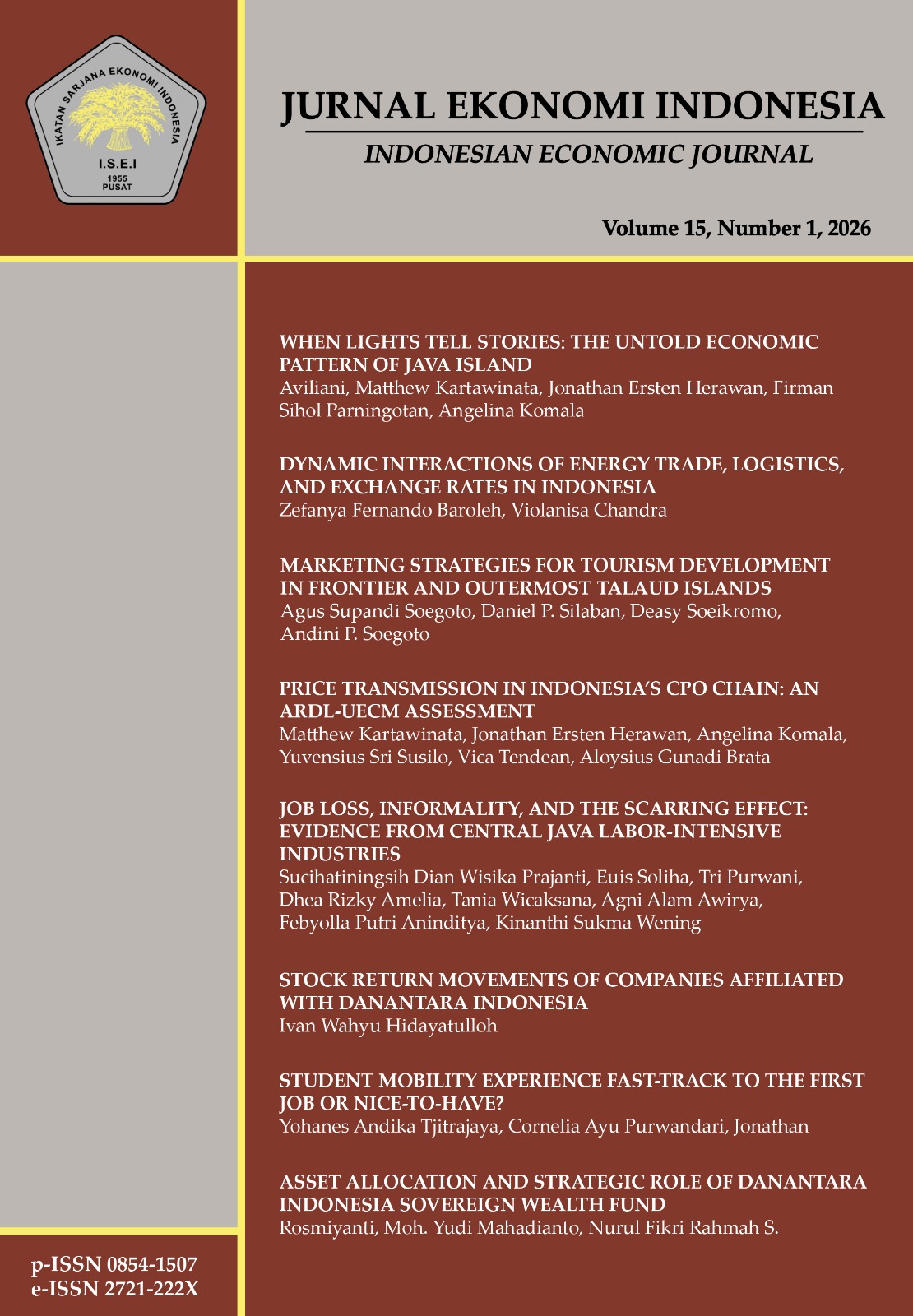
Main Article Content
Abstract
community service, and student exchange, on the time it takes Indonesian graduates to secure their first job. Evidence in the Indonesian context has been scarce, especially for community service. By using data from the 2024 National Labour Force Survey (Sakernas) and applying Propensity Score Matching (PSM), this research provides stronger quantitative evidence on the value of these programmes. The findings show that student exchange shortens job-search time by around 40 days, while community service and internship reduce it by about 35–38 days. These results suggest that SM programmes play an important role in easing the school-to-work transition, with the skills they gain serving as credible signals of their productivity and employability. As the first study of its kind in Indonesia, this research offers timely insights for universities and policymakers. Future work should also explore broader outcomes, such as job quality, earnings, and long-term career development, to better understand the lasting impact of SM programmes.
Keywords
Article Details
References
-
[1] Smith, J. and E. Todd, P. (2005) “Does matching overcome Lalonde’s critique of nonexperimental estimators?,” Journal of Econometrics, 125(1–2), pp. 305–353. Available at: https://doi.org/10.1016/j.jeconom.2004.04.011.
[2] Anjum, S. (2020) “Impact of internship programs on professional and personal development of business students: A case study from Pakistan,” Future Business Journal, 6(1). Available at: https://doi.org/10.1186/s43093-019-0007-3.
[3] Arrow, K.J. (1973) Higher education as a filter, Journal of Public Economics.
[4] Baert, B.S. et al. (2021) “Student internships and employment opportunities after graduation: A field experiment,” Economics of Education Review, 83. Available at: https://doi.org/10.1016/j.econedurev.2021.102141.
[5] Becker, G.S. (1962). Investment in human capital: A theoretical analysis’, Source: Journal of Political Economy.
[6] Caliendo, M. and Kopeinig, S. (2008) “Some practical guidance for the implementation of propensity score matching,” Journal of Economic Surveys, 22(1), pp. 31–72. Available at: https://doi.org/10.1111/j.1467-6419.2007.00527.x.
[7] Deschacht, N. and Vansteenkiste, S. (2021) “The effect of unemployment duration on reservation wages: Evidence from Belgium,” Labour Economics, 71. Available at: https://doi.org/10.1016/j.labeco.2021.102010.
[8] d’Hombres, B. and Schnepf, S. V (2021) “International mobility of students in Italy and the UK: Does it pay off and for whom?,” Higher Education, 82(6), pp. 1173–1194. Available at: https://doi.org/10.1007/s10734-020-00631-1.
[9] Fede, J.H., Gorman, K.S. and Cimini, M.E. (2018) “Student employment as a model for experiential learning,” Journal of Experiential Education, 41(1), pp. 107–124. Available at: https://doi.org/10.1177/1053825917747902.
[10] Gertler, P.J. et al. (2016) Impact evaluation in practice. 2nd ed. The World Bank.
[11] Granja, C.D. and Visentin, F. (2024) “International student mobility and academic performance: Does timing matter?,” Research in Higher Education, 65(2), pp. 322–353. Available at: https://doi.org/10.1007/s11162-023-09755-6.
[12] Hassouna, M.M., Zeinab, · and Zaazou, A. (2024) The impact of undergraduate internships on employability-an empirical study, The Academic Journal of Contemporary Commercial Research.
[13] Iriondo, I. (2020) “Evaluation of the impact of ERASMUS study mobility on salaries and employment of recent graduates in Spain,” Studies in Higher Education, 45(4), pp. 925–943. Available at: https://doi.org/10.1080/03075079.2019.1582011.
[14] Jackson, V., O’Brien, V. and Richards, A. (2023) “Investigating the impact of experiential learning on employability skill development and employment outcomes: A UK case study of MBA students from the Indian subcontinent,” Journal of Education and Work, 36(6), pp. 476–493. Available at: https://doi.org/10.1080/13639080.2023.2231366.
[15] Jelinčić, D.A., Baturina, D. and Franić, S. (2022) “Impact of service learning on social entrepreneurship and youth employment in Croatia,” Interdisciplinary Description of Complex Systems, 20(4), pp. 319–335. Available at: https://doi.org/10.7906/indecs.20.4.2.
[16] Kapareliotis, I., Voutsina, K. and Patsiotis, A. (2019) “Internship and employability prospects: Assessing student’s work readiness,” Higher Education, Skills and Work-based Learning, 9(4), pp. 538–549. Available at: https://doi.org/10.1108/HESWBL-08-2018-0086.
[17] Klein, M. and Weiss, F. (2011) “Is forcing them worth the effort? Benefits of mandatory internships for graduates from diverse family backgrounds at labour market entry,” Studies in Higher Education, 36(8). Available at: https://doi.org/10.1080/03075079.2010.487936.
[18] Knutsen, T.K., Wiborg, V.S. and Wiers-Jenssen, J. (2025) “Impact of international student mobility on international profile of jobs,” Higher Education, 89(5), pp. 1185–1213. Available at: https://doi.org/10.1007/s10734-024-01267-1.
[19] Kwan, C.K. et al. (2025) “Internship: Breaking the vicious unemployment cycle for vulnerable youth,” Children and Youth Services Review, 169. Available at: https://doi.org/10.1016/j.childyouth.2025.108122.
[20] Leuven, E. and Sianesi, B. (2003) “Psmatch2: Stata module to perform full mahalanobis and propensity score matching, common support graphing, and covariate imbalance testing,” Software [Preprint]. Available at: http://ideas.repec.org/c/boc/bocode/s432001.html.
[21] Ma Hok-ka, C., Chan Wing-fung, C. and Chan Cheung-ming, A. (2016) “The long-term impact of service-learning on graduates’ civic engagement and career exploration in Hong Kong,” Journal of Higher Education Outreach and Engagement, 20(4), p. 37.
[22] Margaryan, S. et al. (2022) “Do Internships Pay Off? The Effects of Student Internships on Earnings,” Journal of Human Resources, 57(4). Available at: https://doi.org/10.3368/jhr.57.4.0418-9460r2.
[23] Matthews, P.H., Dorfman, J.H. and Wu, X. (2015) “The impacts of undergraduate service-learning on post-graduation employment outcomes,” International Journal of Research on Service-Learning and Community Engagement, 3(1). Available at: https://doi.org/10.37333/001c.21584.
[24] Ministry of Finance (2022) Bahan Rapat Dengar Pendapat Merdeka Belajar Kampus Merdeka. Available at: https://kampusmerdeka.kemdikbud.go.id/.
[25] Van Mol, C., Caarls, K. and Souto-Otero, M. (2021) “International student mobility and labour market outcomes: An investigation of the role of level of study, type of mobility, and international prestige hierarchies,” Higher Education, 82(6), pp. 1145–1171. Available at: https://doi.org/10.1007/s10734-020-00532-3.
[26] Mseleku, Z. (2024) “Transitioning from higher education to the labour market: The role of graduate internship on youth graduate employability,” Cogent Education, 11(1). Available at: https://doi.org/10.1080/2331186X.2024.2428069.
[27] Mtawa, N., Fongwa, S. and Wilson-Strydom, M. (2021) “Enhancing graduate employability attributes and capabilities formation: A service-learning approach,” Teaching in Higher Education, 26(5), pp. 679–695. Available at: https://doi.org/10.1080/13562517.2019.1672150.
[28] Musa, S., Nurhayati, S. and Boriboon, G. (2025) “The effect of internships on graduates’ employability, soft skills, and digital competence,” Educational Process: International Journal, 17. Available at: https://doi.org/10.22521/edupij.2025.17.306.
[29] Netz, N. and Grüttner, M. (2021) “Does the effect of studying abroad on labour income vary by graduates’ social origin? evidence from Germany,” Higher Education, 82(6), pp. 1195–1217. Available at: https://doi.org/10.1007/s10734-020-00579-2.
[30] Nichols, A., Mitchell, J. and Lindner, S. (2013) Consequences of Long-Term Unemployment, Urban Institute.
[31] Pantaruk, S. et al. (2025) “Fostering future-ready professionals: The impact of soft skills and internships on hospitality employability in Thailand,” Social Sciences and Humanities Open, 11. Available at: https://doi.org/10.1016/j.ssaho.2025.101371.
[32] Pianda, D. et al. (2024) “The impact of internship experience on the employability of vocational students: A bibliometric and systematic review,” Cogent Business and Management. Cogent OA. Available at: https://doi.org/10.1080/23311975.2024.2386465.
[33] Di Pietro, G. (2013) “Do study abroad programs enhance the employability of graduates?”
[34] Reed-Bouley, J., Wernli, M.A. and Sather, P. (2012). Student employment and perceptions of service-learning, Journal of Service-Learning in Higher Education. University of Louisiana System. Available at: www.ulsystem.edu/JSLHE.
[35] Rizzi, L., Grassetti, L. and Attanasio, M. (2021) “Moving from north to north: How are the students’ university flows?,” Genus, 77(1). Available at: https://doi.org/10.1186/s41118-021-00116-8.
[36] Rosenbaum, P.R. and Rubin, D.B. (1983) “The central role of the propensity score in observational studies for causal effects,” Biometrika, 70(1), pp. 41–55. Available at: https://doi.org/10.1093/biomet/70.1.41.
[37] Rothwell, C. et al. (2023a) “Identification of multicultural learning experiences following an international cross-campus medical student exchange programme between the UK and Malaysia: A qualitative study,” BMJ Open, 13(10). Available at: https://doi.org/10.1136/bmjopen-2023-072808.
[38] Schultz, T.W. (1961) “Investment in human capital,” The American Economic Review, 51(1), pp. 1–17.
[39] Schulzetenberg, A.J. et al. (2020) “Improving outcomes of underrepresented college students through community-engaged employment,” International Journal for Research on Service-Learning and Community Engagement, 8(1). Available at: https://doi.org/10.37333/001C.18719.
[40] Spence, M. (1973). Job market signalling, The Quarterly Journal of Economics.
[41] Storgård, C. (2025) “Exchange studies’ impact on employability and future career choices.”
[42] Tsambou, A.D. et al. (2024) “Impact of employment support programs on the quality of youth employment: Evidence from Senegal’s internship program,” Sustainable Development, 32(5), pp. 4606–4632. Available at: https://doi.org/10.1002/sd.2913.
[43] Verhaest, D. and Baert, S. (2018). “The effects of workplace learning in higher education on employment and match quality: is there an early-career trade-off?,” Empirical Economics, 55(3). Available at: https://doi.org/10.1007/s00181-017-1308-4.
[44] Wiers-Jenssen, J. and Støren, L.A. (2021).“International student mobility and the transition from higher education to work in Norway,” Higher Education, 82(6), pp. 1119–1143. Available at: https://doi.org/10.1007/s10734-020-00564-9.
[45] Yue, C. et al. (2024). “Effects of International Student Mobility on Post-Graduation Decisions: Evidence from Chinese Academic and Vocational Graduates,” Journal of Studies in International Education. Available at: https://doi.org/10.1177/10283153231173223.
References
[2] Anjum, S. (2020) “Impact of internship programs on professional and personal development of business students: A case study from Pakistan,” Future Business Journal, 6(1). Available at: https://doi.org/10.1186/s43093-019-0007-3.
[3] Arrow, K.J. (1973) Higher education as a filter, Journal of Public Economics.
[4] Baert, B.S. et al. (2021) “Student internships and employment opportunities after graduation: A field experiment,” Economics of Education Review, 83. Available at: https://doi.org/10.1016/j.econedurev.2021.102141.
[5] Becker, G.S. (1962). Investment in human capital: A theoretical analysis’, Source: Journal of Political Economy.
[6] Caliendo, M. and Kopeinig, S. (2008) “Some practical guidance for the implementation of propensity score matching,” Journal of Economic Surveys, 22(1), pp. 31–72. Available at: https://doi.org/10.1111/j.1467-6419.2007.00527.x.
[7] Deschacht, N. and Vansteenkiste, S. (2021) “The effect of unemployment duration on reservation wages: Evidence from Belgium,” Labour Economics, 71. Available at: https://doi.org/10.1016/j.labeco.2021.102010.
[8] d’Hombres, B. and Schnepf, S. V (2021) “International mobility of students in Italy and the UK: Does it pay off and for whom?,” Higher Education, 82(6), pp. 1173–1194. Available at: https://doi.org/10.1007/s10734-020-00631-1.
[9] Fede, J.H., Gorman, K.S. and Cimini, M.E. (2018) “Student employment as a model for experiential learning,” Journal of Experiential Education, 41(1), pp. 107–124. Available at: https://doi.org/10.1177/1053825917747902.
[10] Gertler, P.J. et al. (2016) Impact evaluation in practice. 2nd ed. The World Bank.
[11] Granja, C.D. and Visentin, F. (2024) “International student mobility and academic performance: Does timing matter?,” Research in Higher Education, 65(2), pp. 322–353. Available at: https://doi.org/10.1007/s11162-023-09755-6.
[12] Hassouna, M.M., Zeinab, · and Zaazou, A. (2024) The impact of undergraduate internships on employability-an empirical study, The Academic Journal of Contemporary Commercial Research.
[13] Iriondo, I. (2020) “Evaluation of the impact of ERASMUS study mobility on salaries and employment of recent graduates in Spain,” Studies in Higher Education, 45(4), pp. 925–943. Available at: https://doi.org/10.1080/03075079.2019.1582011.
[14] Jackson, V., O’Brien, V. and Richards, A. (2023) “Investigating the impact of experiential learning on employability skill development and employment outcomes: A UK case study of MBA students from the Indian subcontinent,” Journal of Education and Work, 36(6), pp. 476–493. Available at: https://doi.org/10.1080/13639080.2023.2231366.
[15] Jelinčić, D.A., Baturina, D. and Franić, S. (2022) “Impact of service learning on social entrepreneurship and youth employment in Croatia,” Interdisciplinary Description of Complex Systems, 20(4), pp. 319–335. Available at: https://doi.org/10.7906/indecs.20.4.2.
[16] Kapareliotis, I., Voutsina, K. and Patsiotis, A. (2019) “Internship and employability prospects: Assessing student’s work readiness,” Higher Education, Skills and Work-based Learning, 9(4), pp. 538–549. Available at: https://doi.org/10.1108/HESWBL-08-2018-0086.
[17] Klein, M. and Weiss, F. (2011) “Is forcing them worth the effort? Benefits of mandatory internships for graduates from diverse family backgrounds at labour market entry,” Studies in Higher Education, 36(8). Available at: https://doi.org/10.1080/03075079.2010.487936.
[18] Knutsen, T.K., Wiborg, V.S. and Wiers-Jenssen, J. (2025) “Impact of international student mobility on international profile of jobs,” Higher Education, 89(5), pp. 1185–1213. Available at: https://doi.org/10.1007/s10734-024-01267-1.
[19] Kwan, C.K. et al. (2025) “Internship: Breaking the vicious unemployment cycle for vulnerable youth,” Children and Youth Services Review, 169. Available at: https://doi.org/10.1016/j.childyouth.2025.108122.
[20] Leuven, E. and Sianesi, B. (2003) “Psmatch2: Stata module to perform full mahalanobis and propensity score matching, common support graphing, and covariate imbalance testing,” Software [Preprint]. Available at: http://ideas.repec.org/c/boc/bocode/s432001.html.
[21] Ma Hok-ka, C., Chan Wing-fung, C. and Chan Cheung-ming, A. (2016) “The long-term impact of service-learning on graduates’ civic engagement and career exploration in Hong Kong,” Journal of Higher Education Outreach and Engagement, 20(4), p. 37.
[22] Margaryan, S. et al. (2022) “Do Internships Pay Off? The Effects of Student Internships on Earnings,” Journal of Human Resources, 57(4). Available at: https://doi.org/10.3368/jhr.57.4.0418-9460r2.
[23] Matthews, P.H., Dorfman, J.H. and Wu, X. (2015) “The impacts of undergraduate service-learning on post-graduation employment outcomes,” International Journal of Research on Service-Learning and Community Engagement, 3(1). Available at: https://doi.org/10.37333/001c.21584.
[24] Ministry of Finance (2022) Bahan Rapat Dengar Pendapat Merdeka Belajar Kampus Merdeka. Available at: https://kampusmerdeka.kemdikbud.go.id/.
[25] Van Mol, C., Caarls, K. and Souto-Otero, M. (2021) “International student mobility and labour market outcomes: An investigation of the role of level of study, type of mobility, and international prestige hierarchies,” Higher Education, 82(6), pp. 1145–1171. Available at: https://doi.org/10.1007/s10734-020-00532-3.
[26] Mseleku, Z. (2024) “Transitioning from higher education to the labour market: The role of graduate internship on youth graduate employability,” Cogent Education, 11(1). Available at: https://doi.org/10.1080/2331186X.2024.2428069.
[27] Mtawa, N., Fongwa, S. and Wilson-Strydom, M. (2021) “Enhancing graduate employability attributes and capabilities formation: A service-learning approach,” Teaching in Higher Education, 26(5), pp. 679–695. Available at: https://doi.org/10.1080/13562517.2019.1672150.
[28] Musa, S., Nurhayati, S. and Boriboon, G. (2025) “The effect of internships on graduates’ employability, soft skills, and digital competence,” Educational Process: International Journal, 17. Available at: https://doi.org/10.22521/edupij.2025.17.306.
[29] Netz, N. and Grüttner, M. (2021) “Does the effect of studying abroad on labour income vary by graduates’ social origin? evidence from Germany,” Higher Education, 82(6), pp. 1195–1217. Available at: https://doi.org/10.1007/s10734-020-00579-2.
[30] Nichols, A., Mitchell, J. and Lindner, S. (2013) Consequences of Long-Term Unemployment, Urban Institute.
[31] Pantaruk, S. et al. (2025) “Fostering future-ready professionals: The impact of soft skills and internships on hospitality employability in Thailand,” Social Sciences and Humanities Open, 11. Available at: https://doi.org/10.1016/j.ssaho.2025.101371.
[32] Pianda, D. et al. (2024) “The impact of internship experience on the employability of vocational students: A bibliometric and systematic review,” Cogent Business and Management. Cogent OA. Available at: https://doi.org/10.1080/23311975.2024.2386465.
[33] Di Pietro, G. (2013) “Do study abroad programs enhance the employability of graduates?”
[34] Reed-Bouley, J., Wernli, M.A. and Sather, P. (2012). Student employment and perceptions of service-learning, Journal of Service-Learning in Higher Education. University of Louisiana System. Available at: www.ulsystem.edu/JSLHE.
[35] Rizzi, L., Grassetti, L. and Attanasio, M. (2021) “Moving from north to north: How are the students’ university flows?,” Genus, 77(1). Available at: https://doi.org/10.1186/s41118-021-00116-8.
[36] Rosenbaum, P.R. and Rubin, D.B. (1983) “The central role of the propensity score in observational studies for causal effects,” Biometrika, 70(1), pp. 41–55. Available at: https://doi.org/10.1093/biomet/70.1.41.
[37] Rothwell, C. et al. (2023a) “Identification of multicultural learning experiences following an international cross-campus medical student exchange programme between the UK and Malaysia: A qualitative study,” BMJ Open, 13(10). Available at: https://doi.org/10.1136/bmjopen-2023-072808.
[38] Schultz, T.W. (1961) “Investment in human capital,” The American Economic Review, 51(1), pp. 1–17.
[39] Schulzetenberg, A.J. et al. (2020) “Improving outcomes of underrepresented college students through community-engaged employment,” International Journal for Research on Service-Learning and Community Engagement, 8(1). Available at: https://doi.org/10.37333/001C.18719.
[40] Spence, M. (1973). Job market signalling, The Quarterly Journal of Economics.
[41] Storgård, C. (2025) “Exchange studies’ impact on employability and future career choices.”
[42] Tsambou, A.D. et al. (2024) “Impact of employment support programs on the quality of youth employment: Evidence from Senegal’s internship program,” Sustainable Development, 32(5), pp. 4606–4632. Available at: https://doi.org/10.1002/sd.2913.
[43] Verhaest, D. and Baert, S. (2018). “The effects of workplace learning in higher education on employment and match quality: is there an early-career trade-off?,” Empirical Economics, 55(3). Available at: https://doi.org/10.1007/s00181-017-1308-4.
[44] Wiers-Jenssen, J. and Støren, L.A. (2021).“International student mobility and the transition from higher education to work in Norway,” Higher Education, 82(6), pp. 1119–1143. Available at: https://doi.org/10.1007/s10734-020-00564-9.
[45] Yue, C. et al. (2024). “Effects of International Student Mobility on Post-Graduation Decisions: Evidence from Chinese Academic and Vocational Graduates,” Journal of Studies in International Education. Available at: https://doi.org/10.1177/10283153231173223.